
Anat Baniel Method® NeuroMovement® is not exercise and not therapy. It is a way of learning: slow, attentive movement that gives the brain new information — and lets it reorganise how you move, feel and think. This page explains where it comes from, how it works, and why it belongs in a Pilates studio.
"Movement is life. Life is a process. Improve the quality of the process and you improve the quality of life itself."
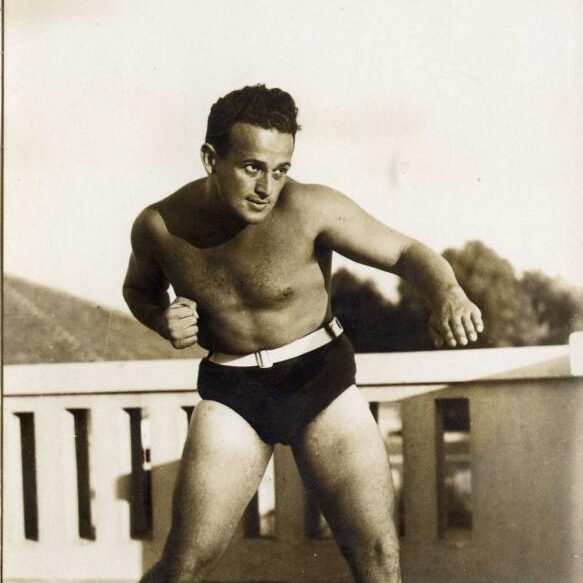
Moshé Feldenkrais is born in what is now Ukraine. He becomes an engineer and physicist in Paris, works alongside Nobel laureate Frédéric Joliot-Curie, and earns one of the first European black belts in judo.
A crippling knee injury, and surgeons who offer only a coin-flip operation, set him teaching himself to walk again. Studying anatomy, neurology and infant development, he discovers that improving how the brain organises movement changes what the body can do. The Feldenkrais Method is born.
He teaches in Tel Aviv, then across Europe and America. Long before the word neuroplasticity was in common use, his premise was that the nervous system can learn at any age — and that gentle, varied, attentive movement is how you teach it.
Anat Baniel — a dancer and clinical psychologist who first did Feldenkrais lessons with her ballet teacher at age seven — becomes his student in Tel Aviv while at graduate school. They work side by side for eleven years; he makes her a trainer in 1981 and insists she develop the work in her own way.
Feldenkrais dies. Baniel continues in the United States, working daily with children with special needs, stroke survivors, athletes and musicians — and asking, every time a limitation dissolved, what exactly the brain had needed in order to change.
She publishes Move Into Life and Kids Beyond Limits, distilling four decades of practice into the Nine Essentials — nine conditions the brain requires to learn. The work is named Anat Baniel Method NeuroMovement, and neuroscientists including Michael Merzenich confirm that her Essentials match the rules of brain plasticity discovered in the laboratory.
Each Essential names one thing the brain needs in order to wake up, form new connections, and stop repeating what it already knows. Every lesson is built on all nine.
Movement alone does not change the brain. Movement you actually feel does. Attention turns repetition into learning.
Fast, you can only do what you already know. Slow gives the brain time to notice differences — and differences are the raw material of new patterns.
Doing a thing several ways, including wrong ways, floods the brain with information. It is how children learn everything, and how adults can again.
Reduce the force. The less effort you use, the finer the differences you can perceive — and the more precisely the brain can refine what it does.
Not cheerfulness — an inner amplifier. What you greet with interest, the brain marks as important and keeps.
Hold the outcome loosely. Rigid goals narrow attention to failure; a flexible one lets the brain find routes you did not plan.
The brain is either in learning mode or in automatic mode. Slowness, curiosity and novelty turn the switch on; habit and strain turn it off.
Imagining a movement fires much of the same circuitry as doing it. Rehearsing in the mind creates real options for the body.
Knowing what you are doing while you do it. The opposite of automatic — and the state in which the brain works at its highest level.
Classical Pilates asks the body for control, precision and flow. NeuroMovement works one layer beneath that — on how the brain organises the body in the first place. Do both, and each makes the other go further.
Springs can only strengthen a pattern the body already has. NeuroMovement widens the pattern — more of the spine, hips and ribs available — so the Reformer has more to work with.
Every body has parts it holds still without knowing. On the apparatus these show up as compensation. A lesson lets you feel them, and once felt, they can change.
Joe asked for exactness. Exactness depends on how finely you sense where you are. NeuroMovement sharpens that sense — the same skill Pilates then puts to work.
When something hurts, pushing through teaches the brain to guard. Slow, gentle lessons take the guard down — so you return to the apparatus moving freely rather than around an injury.
Together they form one practice: NeuroMovement to enlarge what is possible, Pilates to build strength and skill inside it.
In NeuroMovement you are a student, not a patient, and every session is called a lesson. There are three kinds.
Private, hands-on, mostly silent — the practitioner moves you.
You lie fully clothed on a low padded table, sometimes sitting or standing. The practitioner uses slow, gentle touch to move you in small variations, drawing your brain's attention to connections it has stopped noticing — how the pelvis speaks to the ribs, how the head rides the spine. There is little talking, no stretching and no effort on your part. Changes are often immediate; some arrive over the following days.
Best for: pain, old injuries, a specific limitation, or the deepest possible shift in how you move — and the ideal preparation before a private Pilates session.
One to one, guided by voice — you do the moving.
A Transformational Movement Lesson, or TML, is guided entirely in words. Lying or sitting on a mat, you follow the practitioner's instructions through a sequence of small, unfamiliar movements built around a single theme — then notice what has changed. Privately, the lesson is chosen and paced for you alone, and the practitioner can watch how you solve each movement and adjust.
Best for: learning to sense and improve your own movement — a skill you keep, and bring to every Pilates session afterwards.
The same lesson, in a small class.
A group TML follows the same form: the practitioner speaks, you explore. Each person works at their own pace and range — there is nothing to keep up with and no one is corrected. The room is small, the pace is slow, and the lesson ends with everyone standing differently than they arrived.
Best for: regular practice, an accessible first taste of the work, and a calm counterweight to the demands of apparatus classes.
Opening prices — lessons go on sale when booking opens. Packs are priced per lesson, with no discount.
Private, hands-on lesson on the table — the practitioner moves you.
A private Transformational Movement Lesson, guided entirely in words.
The same lesson in a small group, each person at their own pace.
Single sessions are valid for 4 weeks, 5-packs for 8 weeks, 10-packs for 12 weeks from purchase.
The classical Pilates method and its apparatus
NeuroMovement lessons open with the studio. Join the waitlist for the first schedule, or write to us with a question about how the two practices fit together.