
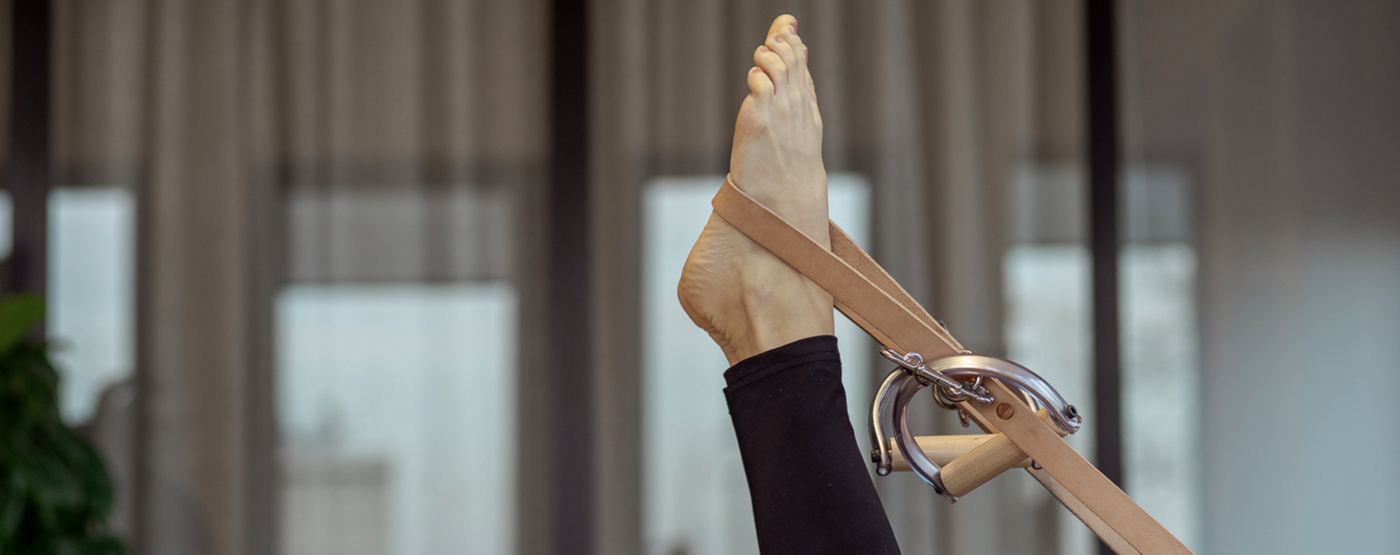
Wear comfortable clothes you can move in, and socks — you will train in them. There is nothing to bring and nothing to know in advance. Arrive ten minutes early, tell us about any injury, surgery, or pregnancy, and we take it from there. That conversation is not a formality: it decides how your session is built.
It is how to breathe, how to find your centre, and how the apparatus works with you. On the reformer, the springs support you before they challenge you — which is why a complete beginner can do real work in the very first hour, without fear and without flailing.
Expect fewer repetitions than you are used to, done more precisely than you are used to. Classical Pilates is taught, not performed: your instructor corrects with her hands, adjusts the springs to your body, and names what you are feeling so you can find it again next time.
You will work — genuinely — but you will not be destroyed. Most people are surprised twice: first by how gentle the hour feels, then by how deeply their body responds the next day. The soreness, when it comes, sits in muscles you did not know you had. That is the deep stabilising system waking up.
We recommend beginning one-to-one, because thirty minutes of individual attention teaches your body more than three group classes — and everything afterwards builds on it. But it is a recommendation, not a rule: our beginner-friendly small sessions of up to seven welcome you from day one, and we teach the apparatus right in class.
However you begin, you leave your first session knowing three things: how the work should feel, what your body needs first, and what comes next. See the session types and times on the schedule page, or read about the method and the apparatus before you come.
Your intro session runs a full hour, one to one. It begins with a short conversation — history, old injuries, what your body does all day — and a few minutes of simply watching how you stand and move. Nothing clinical; your teacher is reading where to begin.
Then you get on the reformer. Footwork comes first — lying down, pressing the carriage against spring resistance — because it shows how your ankles, knees, hips and spine organise under gentle load. From there: fundamentals. Breathing with movement, finding your centre, a first taste of the hundred, some simple mat work. You will not be thrown into choreography; every exercise is chosen for you and corrected by hand as you do it.
The hour ends with a plan: what we saw, what we would work on first, and which path — private sessions or the beginner group — fits you best.
Classical Pilates in the first weeks should leave you feeling taller, opened, and quietly worked — not destroyed. Expect to notice muscles you had forgotten, especially deep in the centre, for a day or two afterwards.
Soreness stays mild by design. The springs assist as much as they resist, and a first session is about precision, not exhaustion. Most people simply report sleeping better that night and standing differently the next morning.
How fast will I progress? Faster than you expect at the start — most people feel a real difference within three or four sessions, because hands-on correction removes months of guessing.
Am I too old, too stiff, too out of shape? No. The system was built to meet bodies where they are; the springs scale from rehabilitation-gentle to athlete-strong. Stiffness is a starting point, not a barrier.
Do I need to be flexible first? The opposite: flexibility is an outcome of the work, not an entry requirement. You come as you are — the method does the rest.