
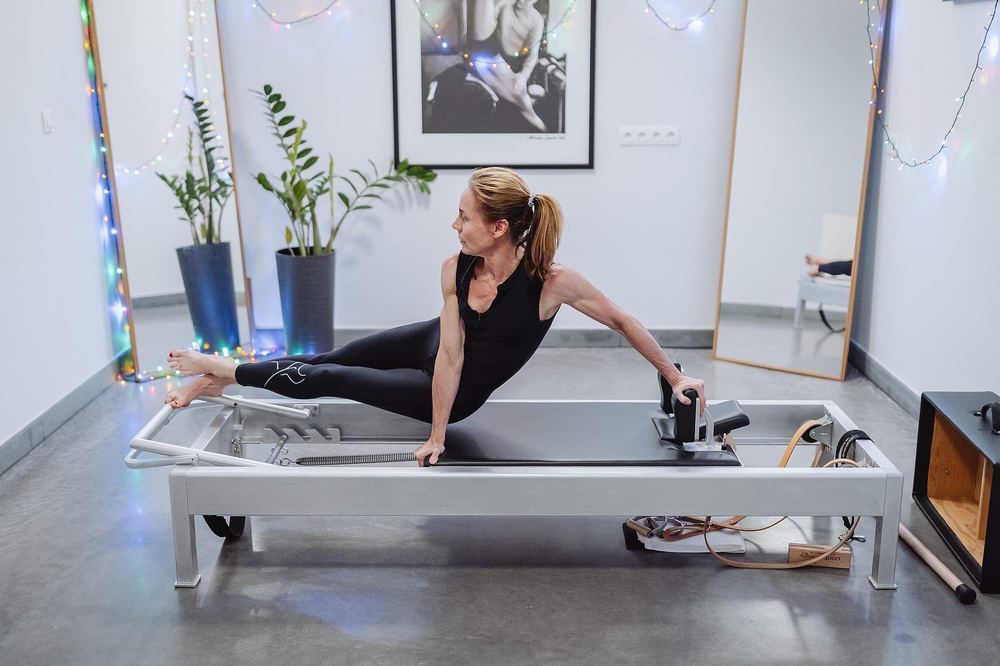
Search Hungarian fitness sites and you will find "classical Pilates" defined as mat work — exercises on the floor, no machines. It is a common shorthand, and it is wrong. Classical Pilates is not a surface. It is the complete, original system Joseph Pilates built and taught until 1967: the mat and the apparatus — Reformer, Cadillac, Wunda Chair, barrels — as one interconnected method.
Three things. The full apparatus, not just rows of reformers. An ordered repertoire — exercises that build on each other in a set progression, so your hundredth session continues what your first began. And lineage: instruction passed down teacher-to-teacher from Joseph Pilates' first generation, learned hands-on over years, not in a weekend certification.
Contemporary studios take real value from the method — good classes, good instructors, real results. The difference is structural: a choreographed group workout that changes weekly serves variety; a system serves progression. Neither is a scam. But they are not the same thing, and they should not be sold under the same name.
Because progression is where the deep change happens. When exercises arrive in order, each one prepares the strength and control the next one needs. Your body stops guessing. Plateaus — the complaint of every long-term class-goer — are designed out of the system, because there is always a next exercise waiting for the body you are building.
Ask what comes after the reformer. A classical studio answers with a path: the Cadillac for this, the Wunda Chair for that, and here is where you are on it. Budapest has had excellent contemporary studios for years. A classical one — the complete system, taught in lineage — is what we are opening.
Read the full story of the man and the machines on the method page, or see how to begin on the schedule.
Joseph Pilates did not leave behind a pile of exercises; he left a sequence. Each movement prepares the body for the next — warming the spine before asking it to articulate, building the centre before demanding balance from it. That is why a classical hour has a recognisable shape anywhere in the world.
The order also makes progress measurable. When your footwork improves, your hundred improves; when the hundred improves, so does everything after it. You are not collecting moves — you are deepening one continuous practice.
The reformer is the doorway, but it was never meant to stand alone. The tower teaches the spine what the reformer's springs began; the wunda chair strips assistance away and asks for pure control; the barrels open the back body in a way no other apparatus reaches.
In a classical studio the machines converse. What you learn on one, you meet again on another from a different angle — and that repetition from new directions is exactly what makes the work stick.
Classical certification is not a weekend course. It is a multi-year apprenticeship — hundreds of hours of personal practice, observed teaching and examination across every apparatus, passed teacher to teacher in an unbroken line from Joseph Pilates' first generation.
That is what the word on our door means: the method as it was handed down — including the details that never made it into any manual.
A few honest signals: the teacher's hands are on you, correcting; the hour follows an order rather than a playlist; the room holds a full set of apparatus, not only reformers; and nobody is performing for a mirror. Find those four things and you have found the real work — in Budapest or anywhere else.